

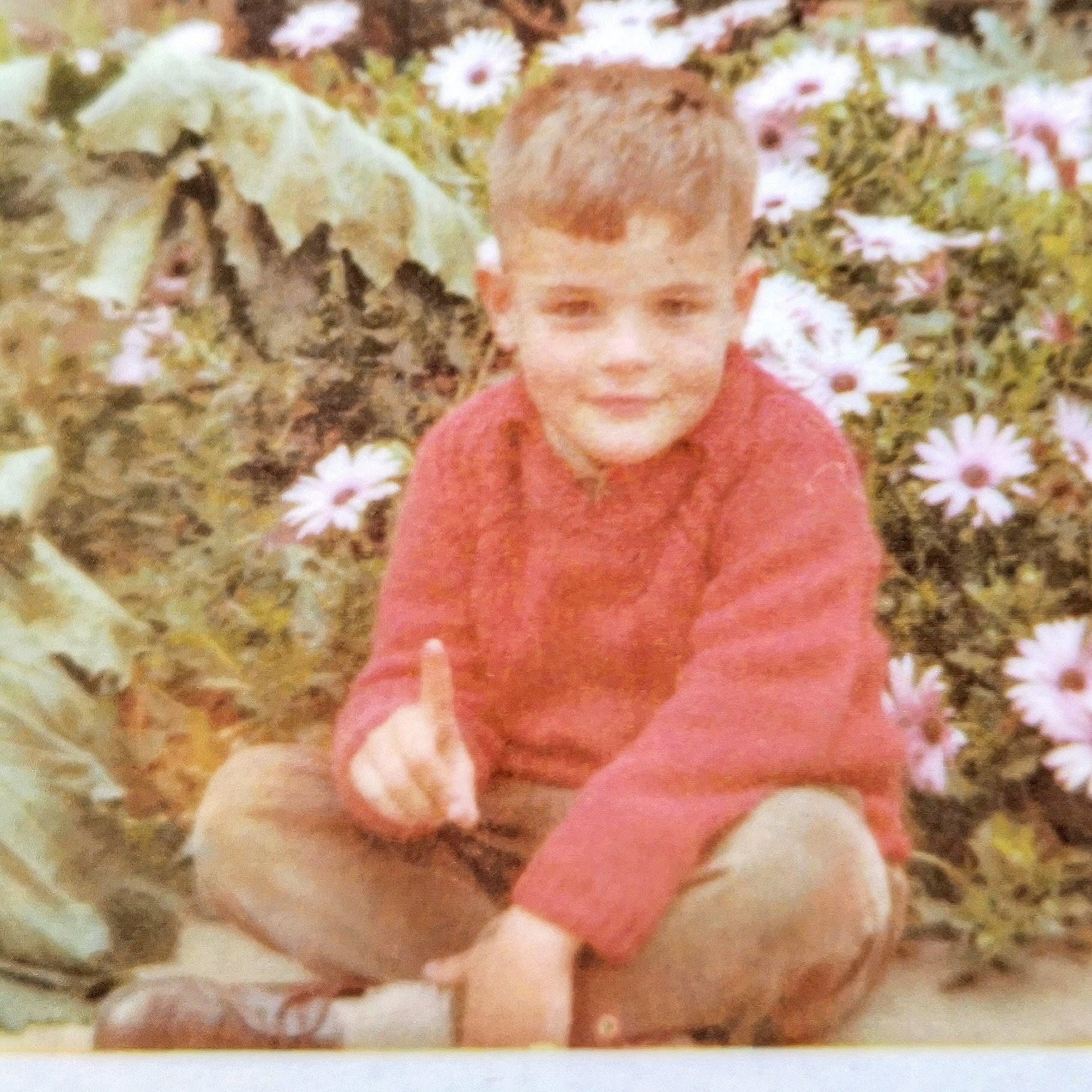
(The image is a photograph my father took of me just before I turned four, sitting in a garden in the town of Nqweba, at the time named Kirkwood, in South Africa)
Towards a Personal Pattern Language for Political Action: Iteration 2026
Manifestoes 1-50: Preparatory actions I can intend without involving anyone else but myself
This tiny manifesto follows directly on Tiny Manifesto #10 (“It is my intention to study what is good for humans, taking into account what is good for the whole earth.’) and is ancillary to and encompassed by it.
I did not grow up imagining that my relation to the land was complicated. My ethnic community, the Afrikaners of South Africa, had provided me with a story of national origin that asserted that we had a morally valid relation to and claim on much of the land of the southern subcontinent of Africa. This claim had been turned into positive law in the South African Land Act of 1913 and further elaborated in the apartheid legislation of the 1950s through to the 1970s. My ethnic community took pleasure in calling itself not only “Afrikaners,” indicating our origin in Africa, but “Boere,” which translates from Afrikaans into “Farmers,” affirming our claim on the land (and especially the agricultural land) we occupied. It was only in my late childhood that I discovered that this ethnic identity—along with both the stories and the laws that supported it—is contestible, and that many people would, alternatively, understand me to be a settler, a descendent of Eurogenic colonizing settlers and a beneficiary of European imperialism and its concomitant White racism. And, indeed, in the most direct patrilineal lineages of descent I am descended from someone born in Strasbourg in Alsace who settled in the trading colony of the Dutch East India Company at the Cape of Good Hope in 1723 and someone from Venice who settled for a time in the same colony in the early 1800s. And I am a settler twice over, in the sense that the privileges with which I was born as such a descendent of Eurogenic settles in South Africa and therefore a White citizen of apartheid South Africa in 1966 very much resemble—both in content and in legal origin—the privileges I was granted as a newcomer to Canada in 1998 who subsequently gained Canadian citizenship.
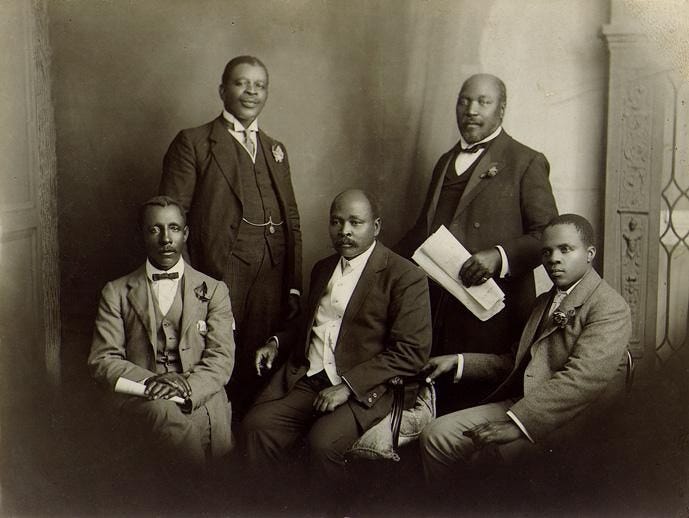
(The image above is a photograph showing an ANC delegation to England in 1914: Thomas Mapike, Rev Walter Rubusana, Rev John Dube, Saul Msane, Sol Plaatjie. The delegation tried to get the British Government to intervene against South Africa’s 1913 Land Act—which was to legalize the theft of the vast majority of land in the country from indigenous peoples in favour of European settlers—but the outbreak of the First World War thwarted their efforts.)
Disentangling what I had imagined to be my relationship to the land I inhabit has therefore been a project since my late childhood. I have benefited in that personal project from the example of the historical projects of others—the truth and reconciliation projects in both South Africa and Canada (the former of which partly employed me in 1996 and 1997), the decolonizing projects throughout the former colonies of Eurogenic empires, and treaty people and land acknowledgement projects in former British colonies such as Australia, New Zealand, and Canada. I can articulate my personal project by declaring that:
It is my intention to acknowledge the land.
That is, it is my intention to come to terms with the moral and political claims on me of the ecosystems I inhabit and of the people who suffer from the political systems governing those ecosystems (political systems that benefit me).
This tiny manifesto implies embedded and adjacent tiny manifestoes that articulate my intention to come to terms with the geology, ecology, and history of the places I inhabit. Among these must be articulations of my intentions to come to terms with the watersheds I inhabit and the treaty relations between the Canadian Crown and the peoples indigenous to the places I inhabit by which I am implicated.
Thank you. My family similarly left Switzerland for Germany, then over to Pennsylvania, and eventually Kansas, where the indigenous populations had been pushed off the land generations before our arrival. I live surrounded by rivers, mountains, and States that still bear the names of the indigenous peoples long displaced. We were taught almost nothing about them in school.