
Tiny Manifesto #163
It is my intention to work for the boundaries of watersheds becoming the primary boundaries of political communities in our present world.

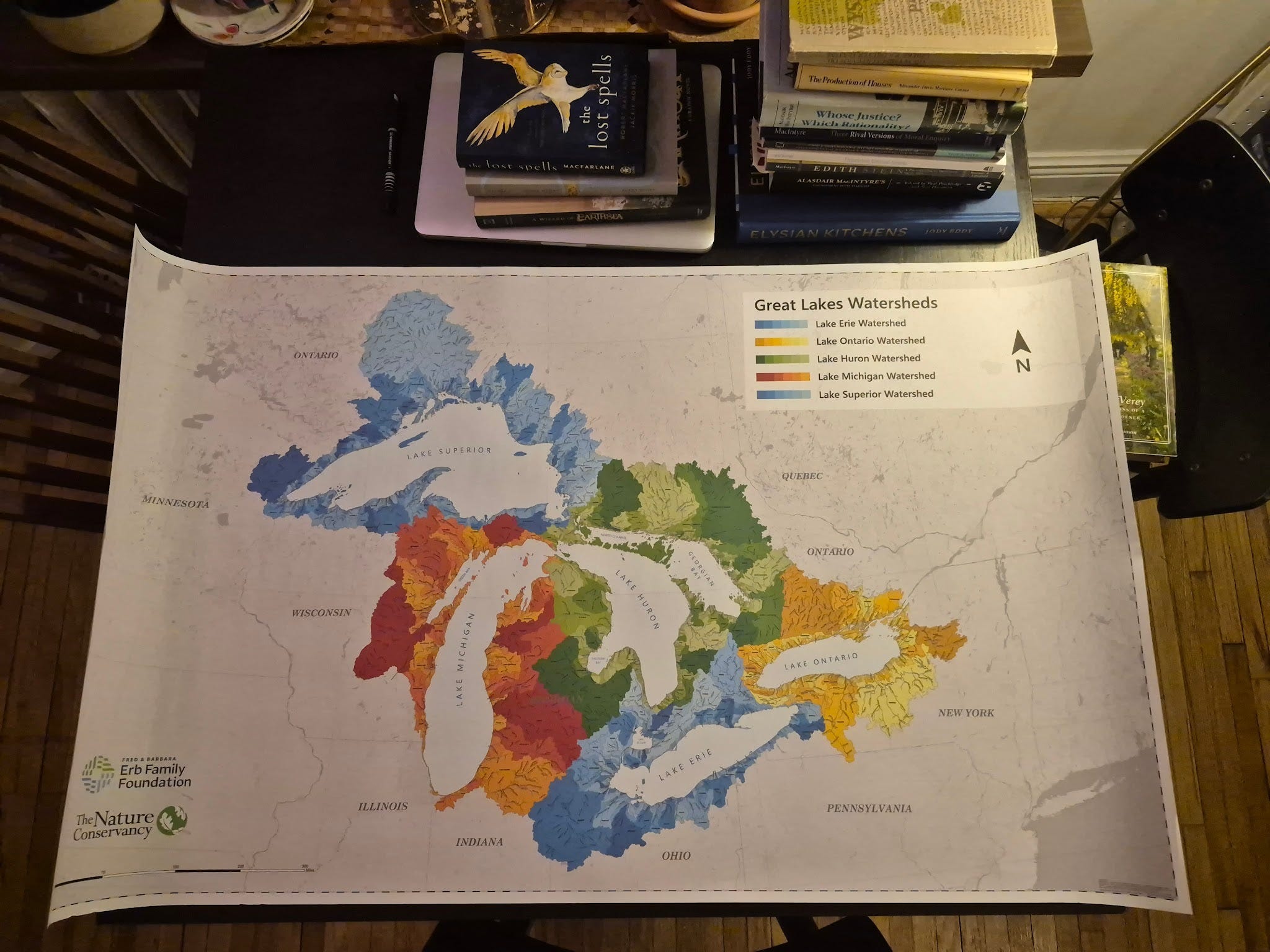
(The image is a photograph I took of a map of the watersheds of the Great Lakes that I recently received from the Erb Family Foundation and The Nature Conservancy.)
Towards a Personal Pattern Language for Political Action: Iteration 2026
Manifestoes 151-200: Actions I can intend in struggle for the emergence of a better successor to the liberal capitalist nation state system of the mid-twenty-first century
I believe there are connections between the following tiny manifesto and my Tiny Manifesto #10 and Tiny Manifesto #13, but I don’t yet know how the connections are best articulated, so I will have to clarify the network of connecting patterns in future posts in this project and future iterations of this project.
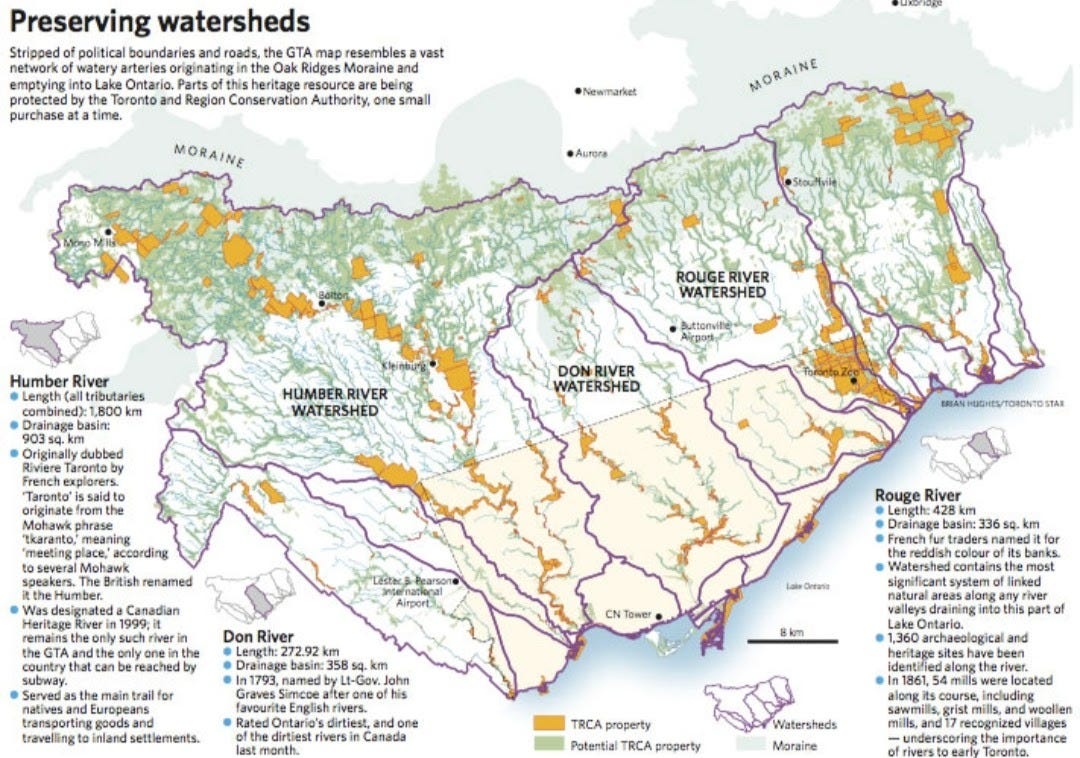
My waters are Yellow Creek, which flows into the Don River, which flows into Lake Ontario, which (along with the waters of the other Great Lakes) flows into the St. Lawrence River, which flows into the Gulf of St. Lawrence, which intermingles through several straits with the Atlantic Ocean. My life-place is situated in the Laurentian Great Lakes.
The work of acknowledging the land, of living in response to an ecologically informed morality, as I want to, involves what the ecological activist Peter Berg called reinhabitation. In an article for The Long Now Foundation about Berg, Gus Mitchell explains: “Reinhabitation is the process of becoming aware of the intricate relational web of a bioregion’s ecological qualities and inhabitants, the ‘biotic community,’ as Berg puts it. One can begin by learning the local watershed—the area defined by the common point where all local water flows eventually end.”
As I asserted in my notes in The Orange Notebook on July 12, 2025 (here and here), the boundaries of watersheds better define the largest prudent sub-planetary political communities than do nation state borders established by war and conquest. And so:
It is my intention to work for the boundaries of watersheds becoming the primary boundaries of political communities in our present world.
Mitchell writes: “Uncovering the history of one’s life-place is another part of a bioregional reorientation, both the natural evolution and the human habitation, including the exploitation that led to its current state. This brings with it an understanding of how the native flora and fauna depend on each other and how they are affected by the seasons, invasive species, and climate change. With this awareness of place, a bioregional polity would naturally start to shape human activities around the enclosing environment, rather than crudely carving a human shape into it. [...] Redefining our location is only one part of a personal bioregional reorientation: there is also uncovering the history of the place, both of natural evolution and human habitation, including the exploitation that led to its current state; the ability to identify its native life (as well as invasive species) and in which seasons and conditions they appear. With this awareness of place, a bioregional polity could re-design the ways in which human activities can fit into the shape of a place rather than stamping crudely on top of it.”
Watershed politics appears to me to be a very long-term politics. Rearranging the political boundaries of the world is the work of generations, of centuries, if it is to be accomplished at all. I have been dipping my toes into the research involved by looking at the materials on the Laurentian Great Lakes (my own most encompassing watershed) produced by the International Association for Great Lakes Research, the Great Lakes Research Alliance, and The Great Lakes Commission. But I imagine the real work this intention requires of me will start with the giving of attention on a much smaller scale. As Gus Mitchell writes: “ask simple questions that connect you tangibly both to your locality and to wider systems. Questions like: what are my closest native plants, animals, berries, and grasses? What is the average rainfall for this time of year? Where does my garbage go? Where does my water come from? Where does my power come from? [...] Get to know where you are — what it was before and what it is now. Look around, at your life-place and the other living things within it. See what they need from you, and discover all that they have to give you back. Start.”
This pattern generates several problems that will require encompassing, adjacent, or encompassed patterns and their key intentions to address, including how and with whom to collaborate in the work for, firstly, the stewarding of the watersheds in which I live under the current conditions of liberal capitalism and the modern nation state (in my life-place, Canada and America and their constituent provinces and states), and secondly, the recognition of watersheds as more appropriate political geographies than modern nation states and their subsidiary parts.