
Tiny Manifesto #17
It is my intention to behold and respect the creatures with whom I co-inhabit the land on which I walk.

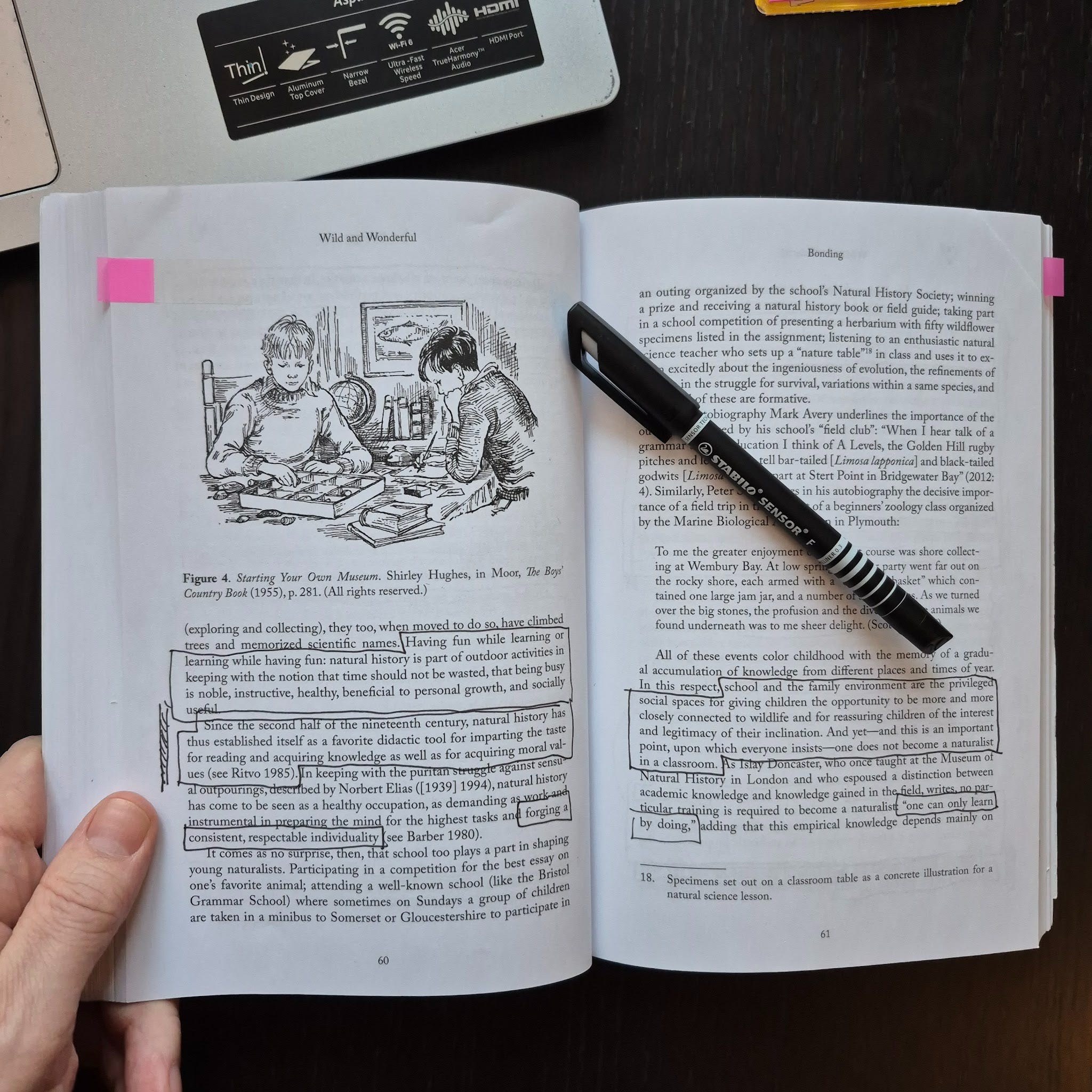
(A couple of pages from Vanessa Manceron’s Wild and Wonderful: An Ethnography of English Naturalists, 2025, open on my desk earlier on the day I am writing this post.)
Towards a Personal Pattern Language for Political Action: Iteration 2026
Manifestoes 1-50: Preparatory actions I can intend without involving anyone else but myself
This tiny manifesto is directly encompassed by Tiny Manifesto #13 (“It is my intention to acknowledge the land”).
My intention to come to terms with the moral and political claims on me of the ecosystems I inhabit and of the people who suffer from the political systems governing those ecosystems will require attention to and study of the geology, ecology, and history of these ecosystems and people. I was moved by some words of Archbishop Rowan Williams recently, quoted by Father Christopher Poore: “ It was our capacity to reason that allowed us to behold and wonder at the world together, to see the order of creation and to participate joyfully in it.” I was reminded of an essay I read years ago by the Reformed philosopher and theologian Richard Mouw, in which Professor Mouw celebrated the human capacity for and calling to beholding, referring to the very early Greek philosopher Anaximander’s catechism for his students, in which Anaximander asked, “Why are you here on earth?” and then provided the answer, “to behold.”
The poetry of the first chapters of the biblical book of Genesis suggest that God’s first response to God’s own creation was one of delight: the poetry tells of God pausing at the end of each passage of creating to consider what has been created, and then to declare it good. Those same chapters describe humanity as being made to reveal, by our actions, what God is like: to bear the image of God among God’s creatures. Which suggests to me that if the God that humanity is to represent to and among all of God’s creatures is a God who delights in those selfsame creatures, then one of the first callings to which humans are to respond is the calling to behold God’s creatures and to delight in them.
I write this post on the day that I, at long last, have finished reading Vanessa Manceron’s Wild and Wonderful: An Ethnography of English Naturalists (2025), translated by Michael Taylor. Manceron’s book is the most recent in a short series of books I have read in the past few years to educate my intention to acknowledge the land. Manceron offers a close study of a handful of amateur birdwatchers and botanists, a bumblebee enthusiast, and a butterfly enthusiast, in Somerset in England, all engaging in these amateur efforts in the tradition of the English naturalist, as she summarizes it (p. 2):
“Without any other need than that of knowing living beings for what they are, naturalists investigate and familiarize themselves with habitats, equipped solely with their senses and sensibility, a notebook in hand, also field guides, and binoculars or a magnifying glass around their neck.”
What is involved in the practices of the English naturalist tradition, according to Manceron (p. 15), is:
“... the very act of observing living beings ‘for themselves.’ It is a matter of feeling wonder at the particularity of each life-form as well as intensifying its presence by allowing it to appear in its own time, permitting it modestly and patiently to deploy itself in front of one so as to let oneself be surprised and captivated by what is happening, while actively taking the time to look and see.”
Manceron’s study describes a practice that seems to me to connect deeply with the posture of beholding celebrated by Archbishop Williams and by Anaximander. She writes (p. 201):
“What we are talking about is [...] a kind of celebration of life-forms and the relationships materialized and made manifest by the act of recording. One thinks of the term ‘respect,’ concerning which Donna Haraway, attentive to the exegesis of the root term specere to clarify the nature of the connection between companion species, writes, ‘looking back in this way takes us to respecere, to the act of respect. To hold in regard, to respond, to look back reciprocally, to notice, to pay attention, to have courteous regard for, to esteem’ [...]. Being attentive to the beings that come into view.”
And so, as an expression of my intention to acknowledge the land:
It is my intention to behold and respect the creatures with whom I co-inhabit the land on which I walk.
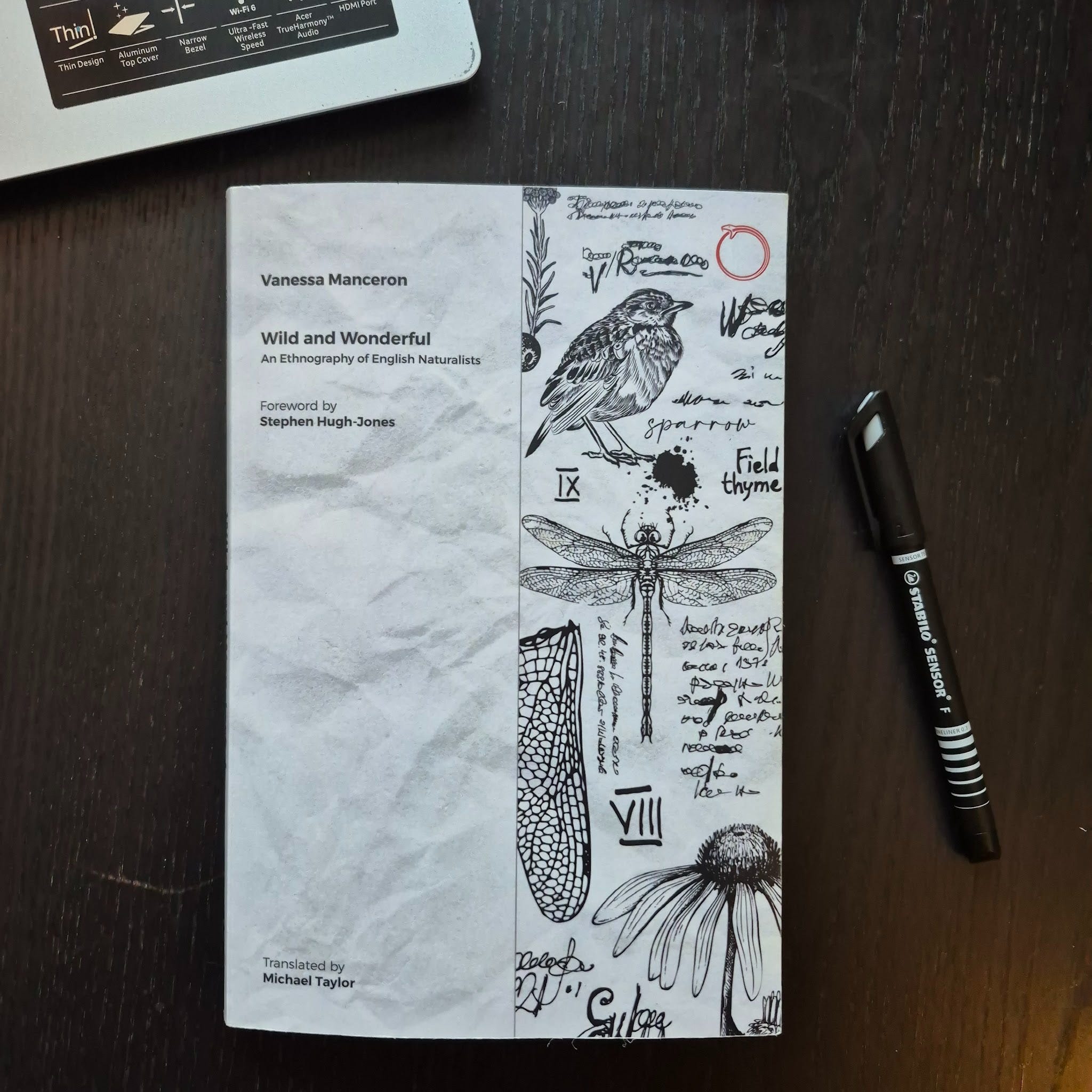
(The cover of Vanessa Manceron’s Wild and Wonderful: An Ethnography of English Naturalists, 2025, on my desk earlier on the day I am writing this post.)
This intention of mine is informed by a desire similar to that expressed by one of Manceron’s naturalist conversation partners (p. 93), a desire for “getting to know where I live, very, very intimately.” In this desire there seems to me a close connection between my own personal formation and my political actions. With regard to the personal formation aspect of this intention, Manceron writes (pp. 68-69):
“Connecting with nature as a naturalist gives one a special place in the world, one that is shared too, owing to the very fact that it exists—an educated and erudite place as well as an emotional and sensorial hyper-connectivity to the natural world.
“This personal connection to living things is the central arch around which everything seems to be built, it is at once a deep personal commitment and a type of awareness that accepts the fact that knowledge cannot be produced independently of the self (and of subjectivity) while at the same time being strictly dependent on the knowledge consigned to books. Amateur naturalists navigate and are steeped in nomenclature and taxonomy; they are more like do-it-yourselfers than creators, more like craftsmen than theorists. It is in this that their capacity for wonder in the world’s incredible diversity lies. Their knowledge is cultivated not because it is deemed useful for its potential application to a particular area of expertise or for contributing to a spectacular scientific breakthrough, but because it cultivates the persons themselves.”
With regard to the political action aspect of this intention, Manceron writes (pp. 222-223):
“The naturalists’ sense of moral responsibility is coloured by their unique relationship with living beings: no intruding or supervising, no looking-down on nor speaking for. They hold themselves at a respectful distance, keep an eye open and attentive; they seek to know what survives and how; they worry and investigate tirelessly; they want these living beings to be recognized and valued, and to this end make them visible. Out of a sense of solidarity and equity [...] they watch over these unobtrusive inhabitants that have too little room in which to live and breathe. Drawing up lists of species amounts thus to politicizing attention. Naturalists shake their head over the abuses of modernity, excessive consumption, the damage inflicted by intensive agriculture, and they aspire to a simple life [...]. Establishing a list of species is a way for them to be of service both to the living and to a collective and citizen-based knowledge to which each contributes according to his or her capacity.”
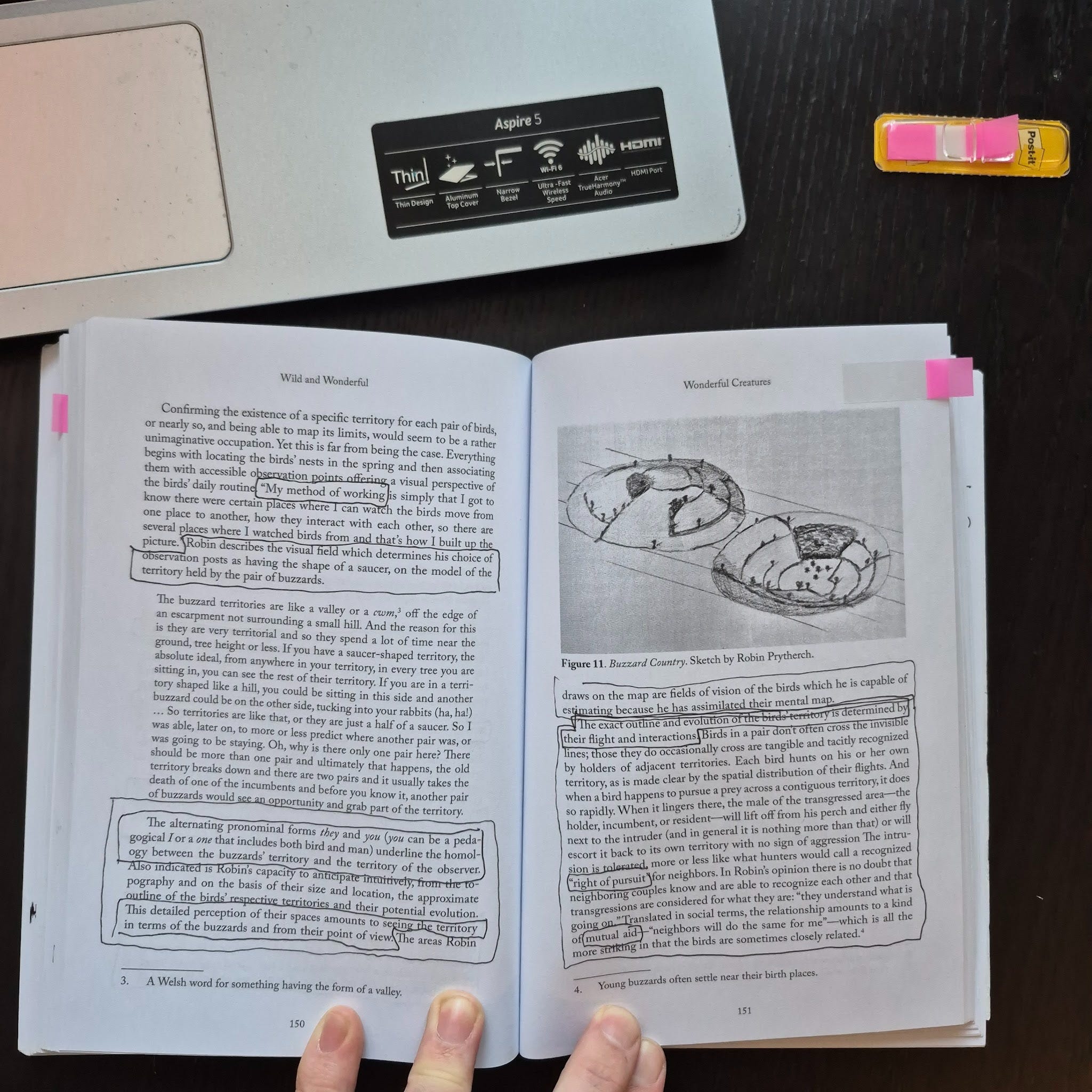
(A couple of pages from Vanessa Manceron’s Wild and Wonderful: An Ethnography of English Naturalists, 2025, open on my desk earlier on the day I am writing this post.)
This tiny manifesto connects with Tiny Manifesto #163 (“It is my intention to work for the boundaries of watersheds becoming the primary boundaries of political communities in our present world”), although I do not yet know how to articulate the connection. The intention encapsulated in this tiny manifestation generations further problems and possibilities: What is the scope of my own capacity for beholding, attending—perhaps the scope of a parish, as is the case of several if not all of Manceron’s naturalist conversation partners? Given the pedestrian character of the naturalist’s practice, how might my walking—in particular, my walking with attention to my fellow creatures as they appear along my walks—be a political act?